
Keyword Density Checker
Total Words
0
Unique Words
0
Keywords Found
0
| Keyword | Occurrences | Density (%) |
|---|---|---|
| No analysis yet. | ||
Need Help Usinig Keyword Density
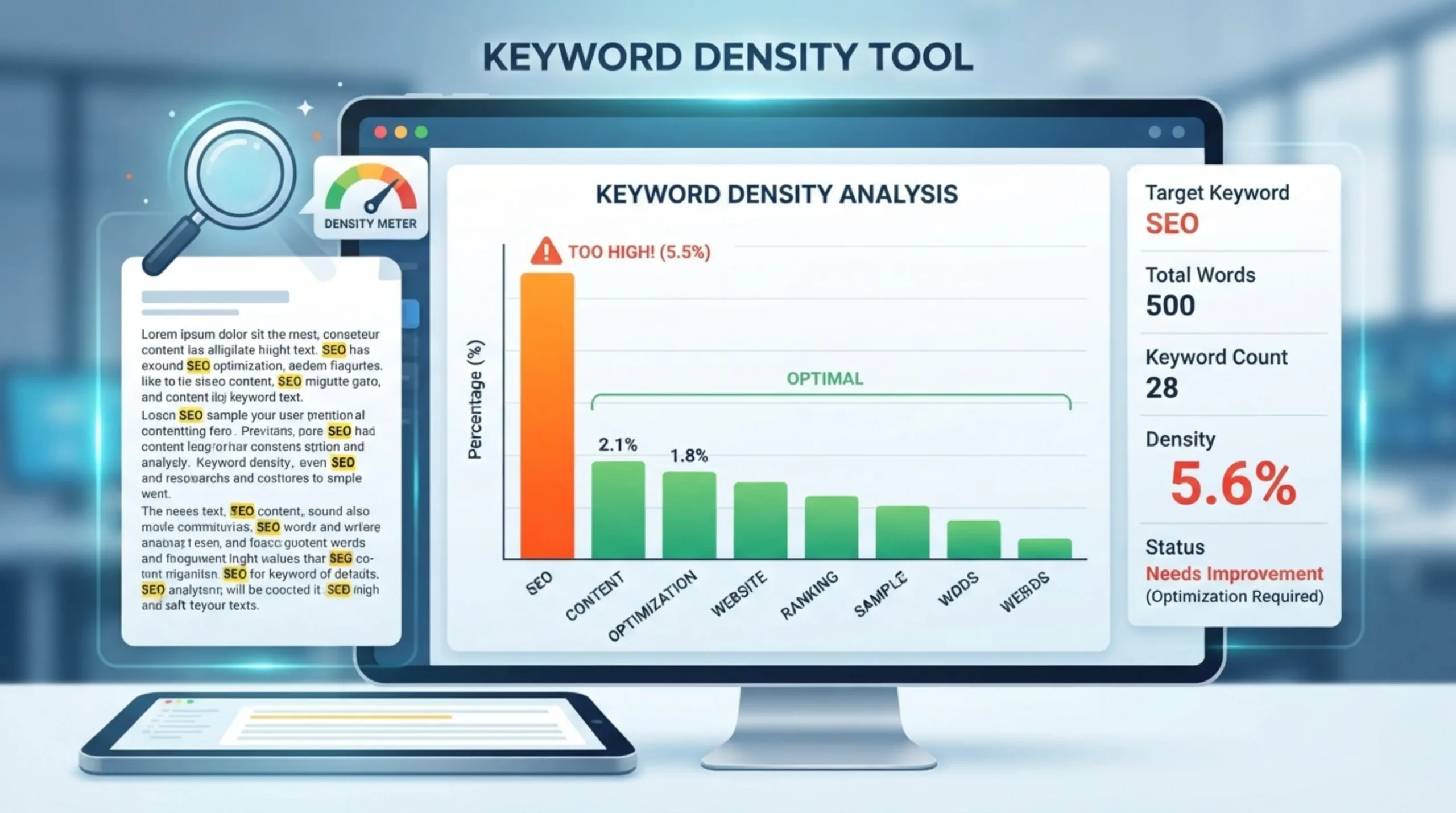
Keyphrase density is how many times your keyphrase appears in your copy divided by the amount of text on that page. So if your text is 100 words long and 5 of them are your target key phrase then your key phrase density is 5% Keyword density is a metric that helps search engines understand what your content is about and how relevant it is to a particular topic. But that’s no longer a major ranking factor. “Now, Google’s semantic search and response algorithms take into account content quality, context and user intent, not just the number of keywords. You need enough keywords that search engines will consider you relevant, but not so many that they will consider you spam.
Keyword Density (%) = (Total number of words / Number of times the keywords appear) * 100 The most experts suggest 1-2% density for keywords. This range is a red flag to search engines without the risk of keyword stuffing penalties. Suppose you have an article that is 1200 words and you’ve used the keyword 14 times. That gives you: 14/1200 = 0.01167. Multiply that by 100 and you get your percentage and your keyword density is 1.167%. This calculation is instantly automated with a keyword density tool so you don’t have to manually count through thousands of words of content.
Best Keyword Density Is 0.5% To 1% This is the best range as it does not cause unnatural keyword stuffing and also helps to meet Google’s E-E-A-T guidelines. A 2,000 word article for a software company that ranks #2 on Google for “best website builders” uses the keyword just 10 times. Most SEO experts recommend that the keyword density should be between 1% and 2% of the total word count. If you drop below that range, you risk creating content that’s too thin to be relevant. If you go over it, you risk triggering keyword stuffing flags and hurting your rankings. The exact sweet-spot is topic, competition and content length dependent
Google explicitly says you shouldn’t keyword stuff – that is, stuff your copy with keywords in an effort to game the system – and it can penalize sites that do. This is a black hat SEO technique where keywords are unnaturally stuffed into content, often leaving the text reading weird and offering little value to readers. Google’s own guidelines say that it’s a violation of their spam policies to “fill a page with keywords or numbers to manipulate rankings.” The penalties can be severe, ranging from a ranking penalty in search results to a complete removal from Google’s index.
A keyword density checker is a tool that measures the keyword density. That is the percentage of how often a keyword occurs inside the content of a webpage divided by the total word count. Keyword density and keyword frequency are still pretty strong indicators of what the main focus keywords and keyword phrases are for a particular webpage. Some tools have a color warning for keywords that are used an abnormally high number of times, so you can easily see which ones you need to pare down. They also split keywords by number of words, and let you exclude certain phrases like stop words for a cleaner analysis.
Default keyword density tools do not show words that are part of the default stop list or are 2 characters or less. You can click a checkbox to enable and disable those features. Common low-value words like the, a, does and is that show up a lot in any text but don’t offer any SEO value are stop words. The SEOBook Keyword Density Analyzer lets you include meta information and exclude stop words, which tend to appear often in a text. You can also specify a min word length, which lets you only include words that meet a certain character count criteria to have a more meaningful analysis.
TF is a measure of the number of times a word appears in your page. The IDF counts how often that word appears in all other web pages. A common word everyplace is less weighted. If it’s on your page and it’s unique it carries more weight. It’s not so much about keyword repetition with Google, it’s about context and related terms. TF-IDF can help you do this, finding the important words and phrases that tell the larger story of your content. With the popularity of the TF-IDF technique, keyword density has been able to place itself better among other SEO techniques. The TF-IDF technique is an algorithm that considers the term frequency of the pages already ranking in search versus the one you are about to publish.
Different versions of keywords – including synonyms, related phrases and LSI (Latent Semantic Indexing) keywords – can help you rank for more searches, without having to repeat the same phrase over and over. If you are able to incorporate keyword variants, LSI keywords, and long tail keyword variations, think about how your article can rank high and comprehensively satisfy the needs of the reader. Google likes content to be relevant, accurate, well-written and that gives a complete answer to a user query. When you semantically enrich your content with LSI keywords, you do so naturally, signaling topical authority to search engines while not artificially inflating the density of a single target phrase.
Back in the days of SEO, keyword density was a big deal. Now, it’s not as big of a deal. Google doesn’t really consider it as a direct ranking factor anymore but the focus is on understanding user intent and providing high quality content. But it can still be part of optimization strategies. Google’s algorithm has moved from a robotic keyword optimization to rewarding quality content and user intent. A well-written, comprehensive article that fully answers the user’s search query will rank better than an article with a higher keyword density and a higher number of keywords, but of poor quality. Metrics like time on page, bounce rate and click through rate are being used increasingly to rate user engagement and rankings.
Place your main keyword and variations in strategic areas with high impact for both users and search engines: the core keyword in the title tag and H1 heading, and variations and related terms in subheadings (H2/H3) to increase semantic relevance. You want to write extensively on the topic, covering the sub-topics related to it, and you want to include keywords strategically in important spots, like the title, headings, and meta description. This kind of “topic coverage” is more likely to satisfy search intent and to provide a better user experience, which is what search engines ultimately want. Where and how often we encounter things matters much more.