
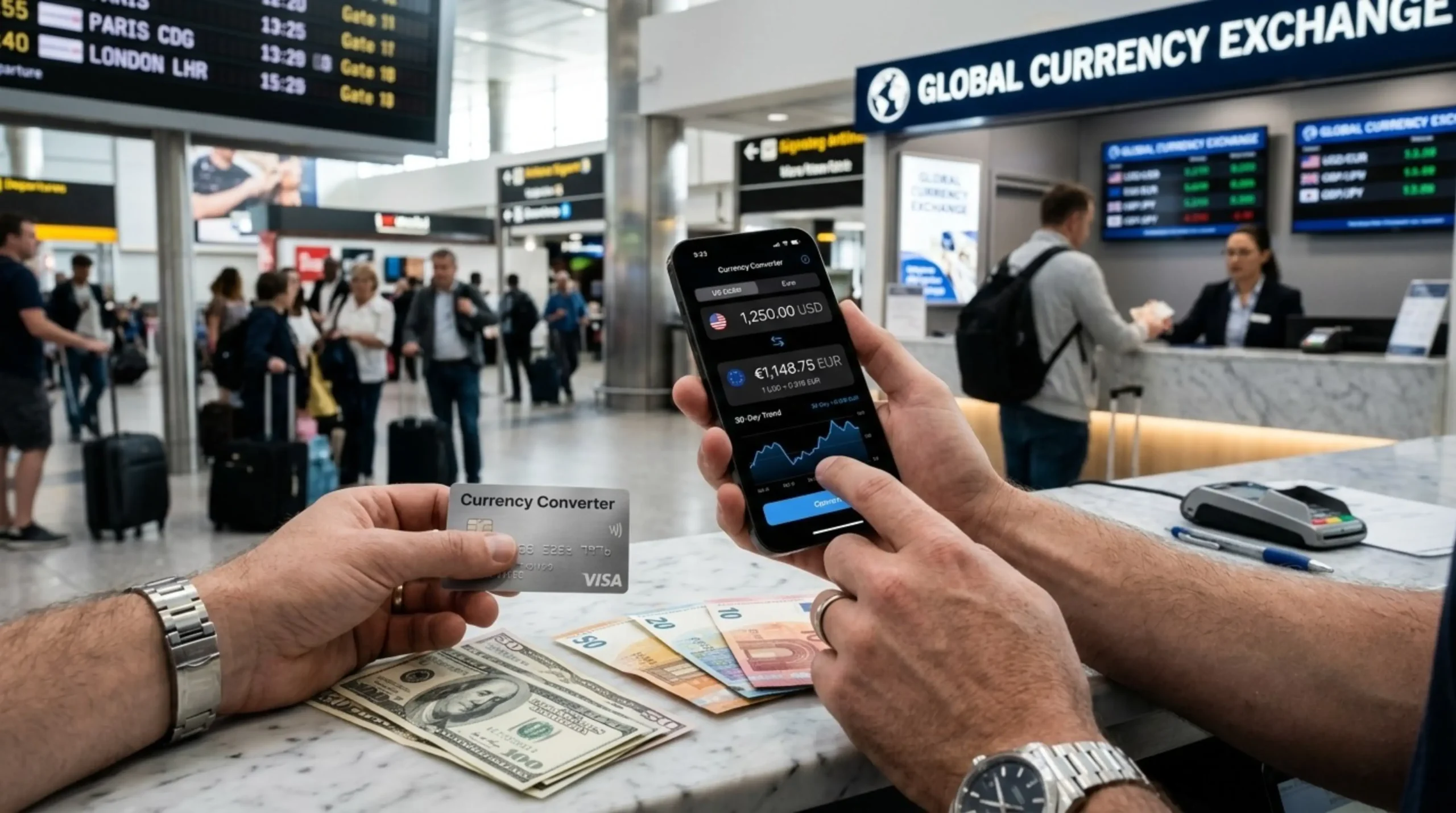
💱 Currency Converter
Need Help Using Currency Converter
A currency converter is an online tool that enables you to convert the value of one currency to another at live or mid-market rates. It collects forex market data from all over the world, central banks or financial APIs. Enter Amount and Source and Target currencies. The tool multiplies it by the current rate of exchange instantly. Many converters online update their rates every few seconds. These can be used to get a quick estimate of your finances, travel budget and plan for international transactions.
An exchange rate is the price at which one currency can be exchanged for another. It’s influenced by a complicated mix of factors such as inflation, central bank interest rate decisions, political stability, trade balances and the mood of global investors. The currency markets are open 24 hours a day, 5 days a week and trillions of dollars are traded each day in the currency markets. The prices you see this morning could change by afternoon. Rates can move at the drop of a hat from a slight change in economic news or geopolitical events.
The mid-market rate, also called the interbank rate or spot rate, is the middle point between the buying and selling prices of two currencies in the global forex markets. It’s the rate that’s on Google and financial data providers. Banks and money exchange services add a markup or margin on top of this rate to make a profit, so you will almost never get the mid-market rate as a regular customer. Depending on the bank, the difference between the mid-market rate and what a bank offers can be anywhere from 1% to over 5%.
The best currency converters get their data from trustworthy sources such as Reuters, the European Central Bank or major forex liquidity providers. Typical tools include Google Currency Converter, XE.com, OANDA and Wise. Many of us trust Google for quick lookups because it displays the mid-market rate in real time. For more detailed historical charts, XE.com and OANDA. If you’re moving money, Wise (formerly TransferWise) consistently ranks high for having rates closest to the mid-market rate, with transparent fees.
Currency conversion usually involves multiple fees: a conversion margin (the difference between market and offered rate), a fixed transaction fee per transfer, and sometimes a correspondent bank fee for international wire transfers. Credit card foreign transaction fees typically run 1–3%. If you pay in your home currency at ATMs abroad, you may be charged dynamic currency conversion fees. Always compare the total cost before converting money, not just the exchange rate, as a small margin on a large amount can make a big difference to your savings or loss.
Yes, a lot of the modern currency converters provide crypto conversions as well as the traditional fiat currencies. Use CoinGecko’s FREE crypto currency converter calculator to convert between cryptocurrencies and fiat currencies. Convert Bitcoin (BTC), Ethereum (ETH) and thousands of other cryptocurrencies to USD, EUR, PKR and more. Over 100 fiat currencies. However, crypto prices are highly volatile and can change quickly in minutes so any converted number is just a snapshot and not a guarantyd price. Always make sure you are using a platform linked to live exchange data when making financial decisions with cryptocurrency conversions.
Purchasing power parity (PPP) is an economic theory that compares different countries’ currencies thru a basket of goods approach. PPP is a popular way to compare the cost of living between countries. A simplified PPP measure is the famous ‘ Big Mac Index ‘ from The Economist . PPP rates are good for comparing standards of living, wages and GDP between countries. Although they are far from market rates, they give economists an idea of whether a currency is over- or undervalued against what it can actually buy at home.
If you are traveling to a foreign country, there are a few different ways you can exchange your currency: ATMs at your destination (these usually give you a rate close to the mid-market rate), local banks or post offices, currency exchange bureaus (airport currency exchanges are usually the worst), or by using a travel credit card that doesn’t charge foreign transaction fees. Avoid dynamic currency conversion at the point-of-sale; always opt to pay in the local currency. If you get a multi-currency travel card like Wise or Revolut and load it up before you go, you can lock in good rates and avoid surprise fees.
A fixed exchange rate, also known as a pegged rate, is when a country’s government or central bank ties the value of its currency to another major currency, like the US dollar, or to gold. Examples include the riyal of Saudi Arabia pegged to the USD. A floating exchange rate is one that moves freely with supply and demand in the open forex market – most major currencies such as the euro, pound and yen are floating. Others have a managed float, where they allow rates to float, but intervene within a range. The choice has implications for trade competitiveness, inflation and monetary policy flexibility.
The dollar of the United States became the world’s main reserve currency following the Bretton Woods Agreement in 1944, which established the dollar as the international standard with gold backing. The dollar remained a dominant currency even after the gold standard ended in 1971 thanks to the huge size of the US economy, the depth and liquidity of US financial markets, as well as political stability and trust in American institutions around the world. USD is the price of most commodities, the most obvious example being oil. Central banks across the world have large dollar reserves, which enhances its status and makes the dollar the anchor currency in most exchange-rate calculations.