
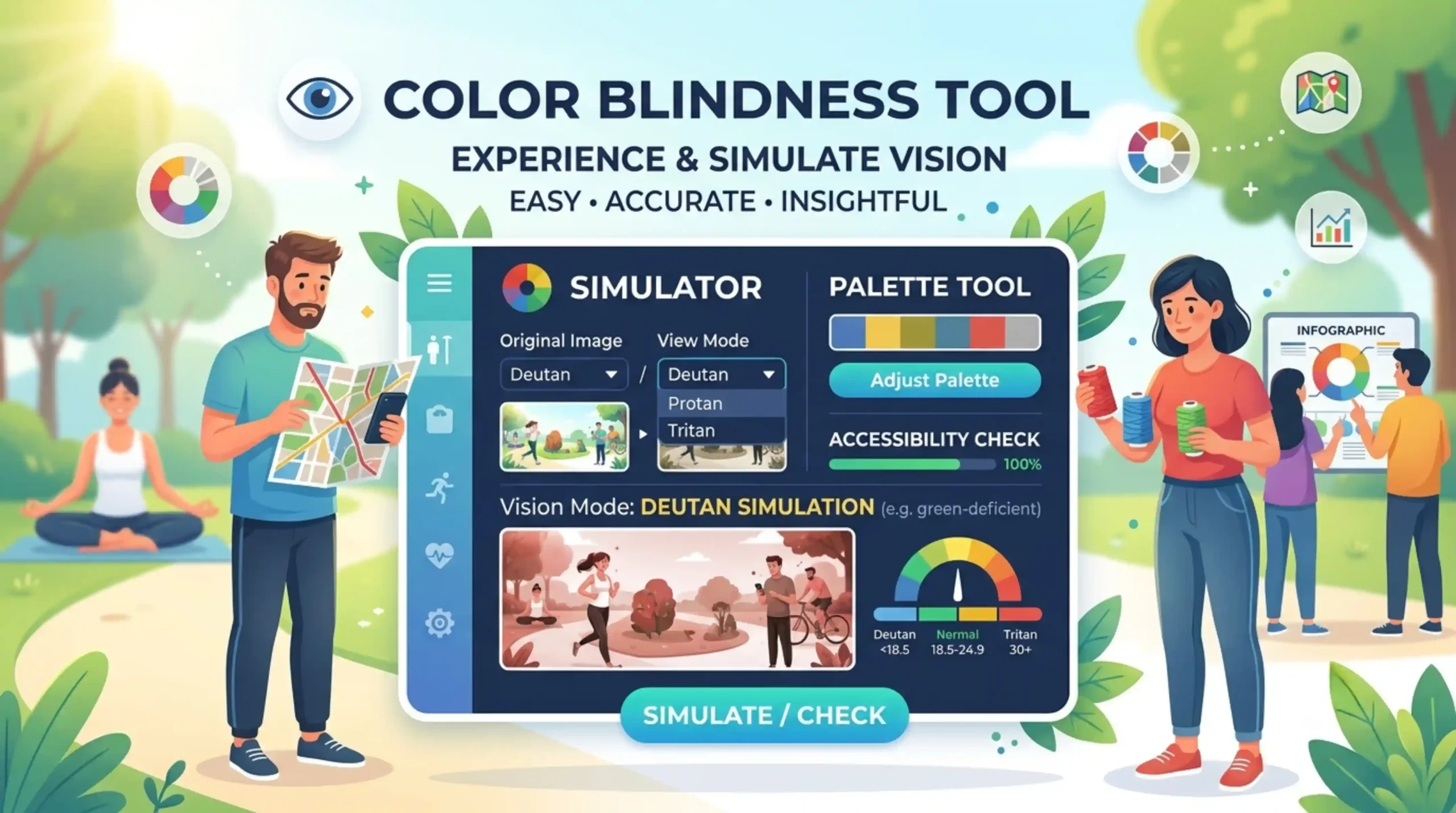
Color Blindness Simulator
Original Image
Protanopia
Deuteranopia
Tritanopia
Need Help Using Color Blindness
Color blindness is more appropriately referred to as color vision deficiency (CVD), and is a condition where an individual is unable to see colors normally. The human eye has special photoreceptor cells called cones that detect red, green and blue light. If one or more types of cones are missing or not working properly, the brain receives incorrect or incomplete color information. But most color-blind people can still see a variety of colors — it’s just hard to tell the difference between a few of them, especially the red-green combinations. Very rarely a person is unable to see any colour at all.
There are three major types. Anomalous trichromacy (most common, ~75% of cases) means that there are three types of cones, but one of them is not working properly, subtypes being protanomaly (weak red cones), deuteranomaly (weak green cones), or tritanomaly (weak blue cones). Dichromacy is more severe, with one cone type missing, resulting in protanopia, deuteranopia or tritanopia. The rarest type is monochromacy (achromatopsia), where two or all three cone types are missing, and the person can only see shades of gray. Worldwide the vast majority of cases are red-green deficiency.
The number one cause is genetics. Most inherited forms are X-linked recessive, with the relevant opsin genes on the X chromosome, which is why males are much more often affected than females. Besides genetics, you can become color blind from eye injuries, damage to the optic nerve or brain, certain neurological diseases (Parkinson’s, multiple sclerosis, Alzheimer’s), cataracts that cloud the lens, some medications, and the natural aging process. Environmental damage to retinal tissue may also affect cone function. If the loss of color vision is due to an underlying condition, treating that condition may help restore some color vision.
Some 300 million people worldwide have some kind of color vision deficiency. Gender heavily influences prevalence: about 8 percent of males and only 0.5 percent of females worldwide are affected. The condition affects about 1 in 12 men and 1 in 200 women in the US alone. About 98% of all cases are red-green color blindness. Prevalence also varies by ethnicity – men of Northern European descent have rates of around 8-10%, while some other populations have lower rates. The country with the highest absolute number of affected persons is China (about 107 million persons).
Symptoms may be mild to very severe. The most common symptom is that of not being able to distinguish red from green, orange and brown – these colors seem to be alike or indistinct. Blue-yellow forms produce confusion between blue and green, or yellow and purple. In rare cases, people can see very little color at all. Many people don’t know they have the condition for years, with about 50% of color-blind people said to not know until about the 7th grade. It often becomes apparent in school activities that require color identification, driver license tests or vision screening for occupations. However, sudden loss of color vision warrants urgent medical attention.
The most common diagnostic tool is the Ishihara color test . This test consists of a series of plates with numbers or patterns hidden in colored dot patterns. These numbers or patterns are clearly visible to a person with normal color vision, but those with deficiencies cannot see them . Eye care professionals may also use the Farnsworth-Munsell 100 Hue Test or anomaloscope for more precise assessment of the type and severity of deficiency. Testing is straightforward and non-invasive. Since many cases go undetected for years, especially in children, routine screening during early schooling or pediatric eye exams is strongly recommended for timely identification.
Inherited color blindness cannot be cured at present. There are a number of management tools that can help, though. Specially tinted glasses and contact lenses, such as EnChroma lenses, filter specific light wavelengths to enhance color contrast and make it easier for some people to see colors, but they don’t restore normal vision. Smartphone apps can identify colors in real-time through the camera. Operating systems and websites increasingly offer color-blind-friendly display modes. For acquired forms caused by illness or medication, treating the root cause may improve color perception. The majority of people adapt quite well using position, luminance, labels, and context clues.